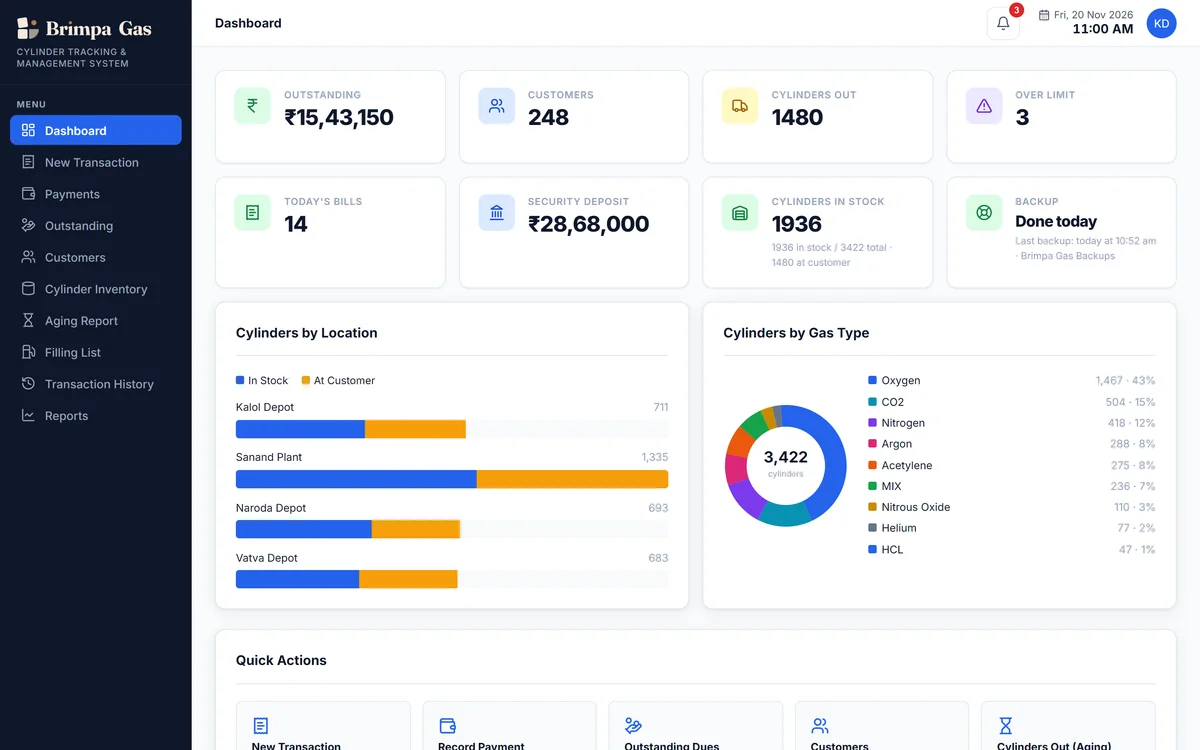

The problem
A gas distributor owns thousands of cylinders that are always somewhere else: at a customer, on a truck, at the filling plant, in a yard. Paper registers answer "where is cylinder 4471" only after a phone call. Rent is charged by the day a cylinder stays out, so a missed return costs money twice: once in rent never billed, once in a cylinder that quietly stops coming back.
Cylinder tracking software earns its keep on exactly those two questions: where is every cylinder right now, and what does each customer owe for the ones they are holding.
What it does
Every cylinder is a record
Its serial or rotation number, gas type, size, and its own history: fills, deliveries, returns and transfers between locations.
Location and state, tracked separately
A cylinder sits at the plant, an office or a customer, and is either in stock or out with a customer. Keeping the two apart is what stops a cylinder from being "lost" when it is only in transit between two of your own sites.
Customers and their holdings
Which cylinders each customer has right now, for how long, against what holding limit, and what rent that adds up to by the day.
Customer-owned cylinders
Tracked by quantity per customer, gas and size, without pretending they are yours.
Filling vendors
Handled with the flow the right way round: cylinders go out empty to be filled and come back full, the opposite of a customer.
Bills, payments and rent
Bills, payments and rental charges with gap-free numbers per account, and printed documents in the distributor's own business identity.
Daily sales and stock
The daily sales report and the stock summary, computed separately on purpose so one cannot hide a mistake in the other. Filling log, purity test certificates, reports and Excel exports, with search and pagination that hold up at tens of thousands of records.
Entries in the right order
Backdated and out-of-order entries are settled by replaying the cylinder's history up to that date, so an entry typed in the evening for a morning delivery lands in the right place. Maintenance is a flag on a cylinder standing at the maintenance location, never a fake movement.
A cylinder's journey, step by step
- Record the cylinder. Its serial or rotation number, gas type and size, with its history from that day on.
- Deliver it. It is placed with the customer, and the days held, the holding limit and the rent due are counted from there.
- Take it back or move it. Location and stock state follow the movement, whether it returns from a customer or moves between your own sites.
- Send it for filling. It goes out empty to the filling vendor and comes back full, and that too stays in its history.
Who it is for
Distributors of industrial and medical gases who own the cylinders they deliver: oxygen, nitrogen, argon, carbon dioxide and the rest, in any mix of sizes. It fits a single yard as well as a business with a filling plant and several delivery offices, because locations are a list and transfers between them are just another movement. It is not built for consumer LPG connections, and it does not drive filling hardware.
How it is built
- One installation, every business an account. Each record carries its account's id and every query filters by it; the discipline is written down and tested, and a client can still be moved to its own database later as a deliberate choice.
- Licence-only sign-up. Brimpa issues a licence for an email address, stored only as a hash; a one-time code goes to Brimpa, not the client, so no account exists without the vendor knowing. Creating the account, binding the licence and writing its catalog is one transaction.
- Each account gets its own catalog of gas types and cylinder sizes, and a permanent account code that appears on its documents.
- Time is handled explicitly. Two production incidents came from timezones; the rules now fix how every date is stored, compared and shown.
- The business rules are a numbered ledger kept with the code, so a fix later cannot quietly remove a rule nobody remembered.
- Backups and restore are part of the product, with a restore job that is tested, not assumed.
- A vendor API lets the licensing panel in Brimpa Care manage Brimpa Gas licences from one place.
Questions
Does it work for a distributor with one location?
Yes. Locations are a list, and a business with one yard uses one. A business with a filling plant and two offices, which is how it runs today, uses three, and the transfers between them are recorded like any other movement.
Can my staff use it on a phone?
Yes. It runs in a browser, so it works on the office computer, a phone at the plant and a tablet on the delivery truck. There is nothing to install and nothing to update by hand.
How do I get an account?
Ask for a demo from the contact page. If it fits, Brimpa issues a licence for your email address and your account is set up with your gas types, cylinder sizes, locations and documents, usually within days.
Is my data separate from other businesses?
Yes. Every record carries your account, every query is filtered by it, and that rule is written down and tested. You can export your data at any time, and a business can be moved to its own installation later as a deliberate choice.
What does it cost?
It is licensed per account. The price depends on the number of locations and users, and is written into the licence agreement before the account is opened. Ask for a demo and you get the figure with it.
Does it handle LPG home connections?
No. It is built for distributors who own the cylinders they deliver to businesses, hospitals and workshops: industrial and medical gases in returnable cylinders. Consumer LPG with subsidised connections is a different business and a different system.